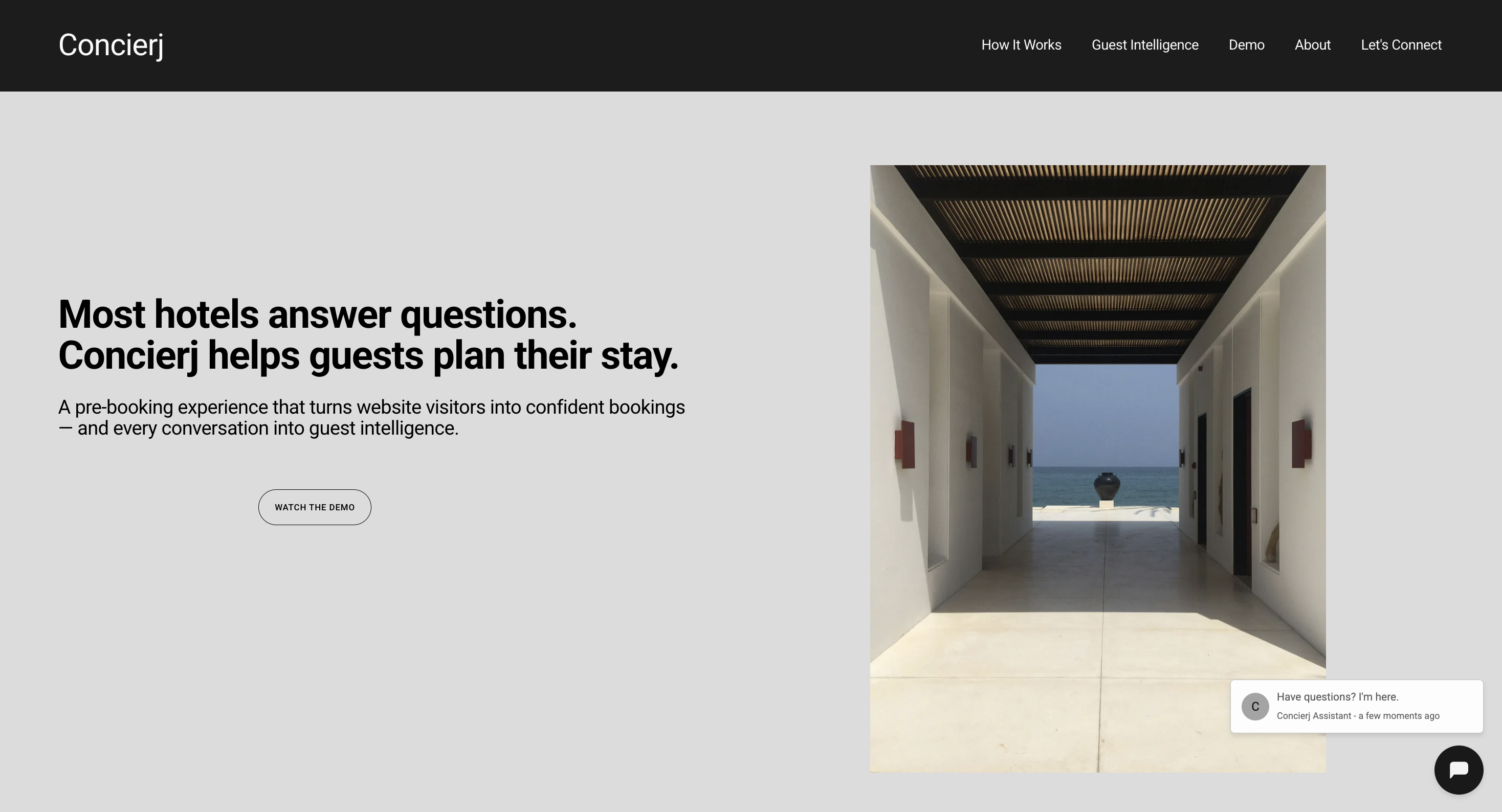
Concierj
A conversational AI system that recovers boutique-hotel guests lost in the pre-booking funnel, designed and built solo, 0 → 1, in 12 weeks.
Overview
Boutique hotels lose guests before they ever book, and it rarely comes down to price or availability. There's no one to answer a question in real time, read what a guest actually needs, or move them from curious to confident. I built Concierj to close that gap: a conversational system that reads guest intent, guides different types of travelers toward a decision, and knows when to bring a person in.
The result is a 0 → 1 conversational AI system, designed and built solo in 12 weeks from concept to live launch and tested across 200+ conversations: it reads intent, personalizes guidance, recovers when a guest goes off script, and escalates to staff when it should.
Building it was also how I taught myself to design, test, and ship a conversational AI system end to end, not only close a business gap.
01 — Understanding the people
I ran 59 interviews across four stakeholder groups: boutique hotel owners, front desk staff, guests, and travel agents, to find exactly where the pre-booking funnel broke down and for whom. I wasn't testing a solution; I was diagnosing the drop-off.
Alongside the interviews, I mapped the competitive landscape and defined what a conversation would need to understand about a guest, and what it would need to track, to make the funnel measurable.
Key insight 1: Hotel Owners
Owners wanted it handled for them — no more tools to manage. Overwhelmed by repetitive queries and after-hour inquiries.
Key insight 2: Front Desk Staff
Missed and duplicated responses across shifts were a systemic problem, not a staffing one. Overwhelmed by repetitive queries, wanted lead capture segmentation.
Key insight 3: Guests
Unanswered pre-booking questions led to a different property. Wanted instant pre-booking answers and trip guidance.
Key insight 4: Travel Agents
Needed more information on property qualifications and policies for group trip planning. Can't always rely on 1:1 relationships to grow business.
02 — Designing the conversation
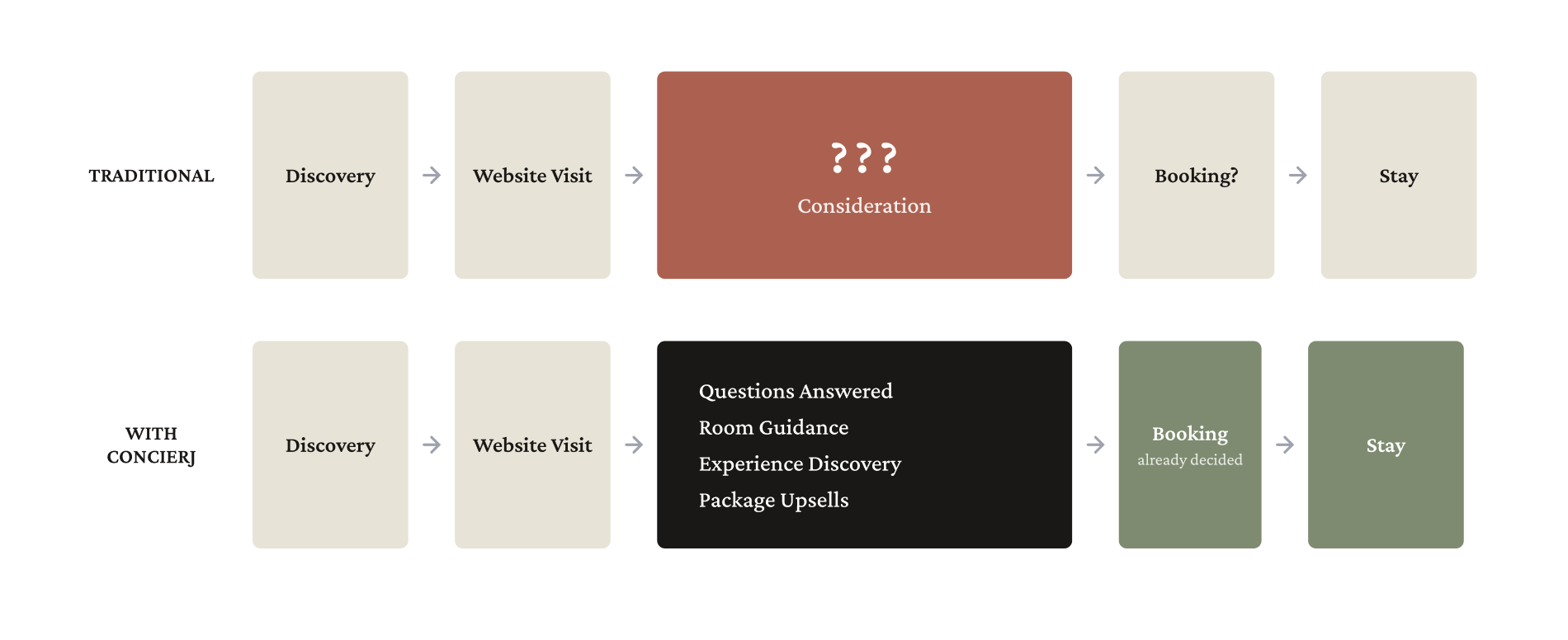
Research surfaced a missing consideration stage between website visit and booking. The next step was designing how a conversation would carry a guest through it: what the system needed to know at each point, and when a person needed to step in instead.
I evaluated several technical approaches and settled on a streamlined Botpress and Claude stack, cutting the complexity the research had flagged as unnecessary. The resulting flows, architecture, business rules, and data requirements became the blueprint for the prototype.
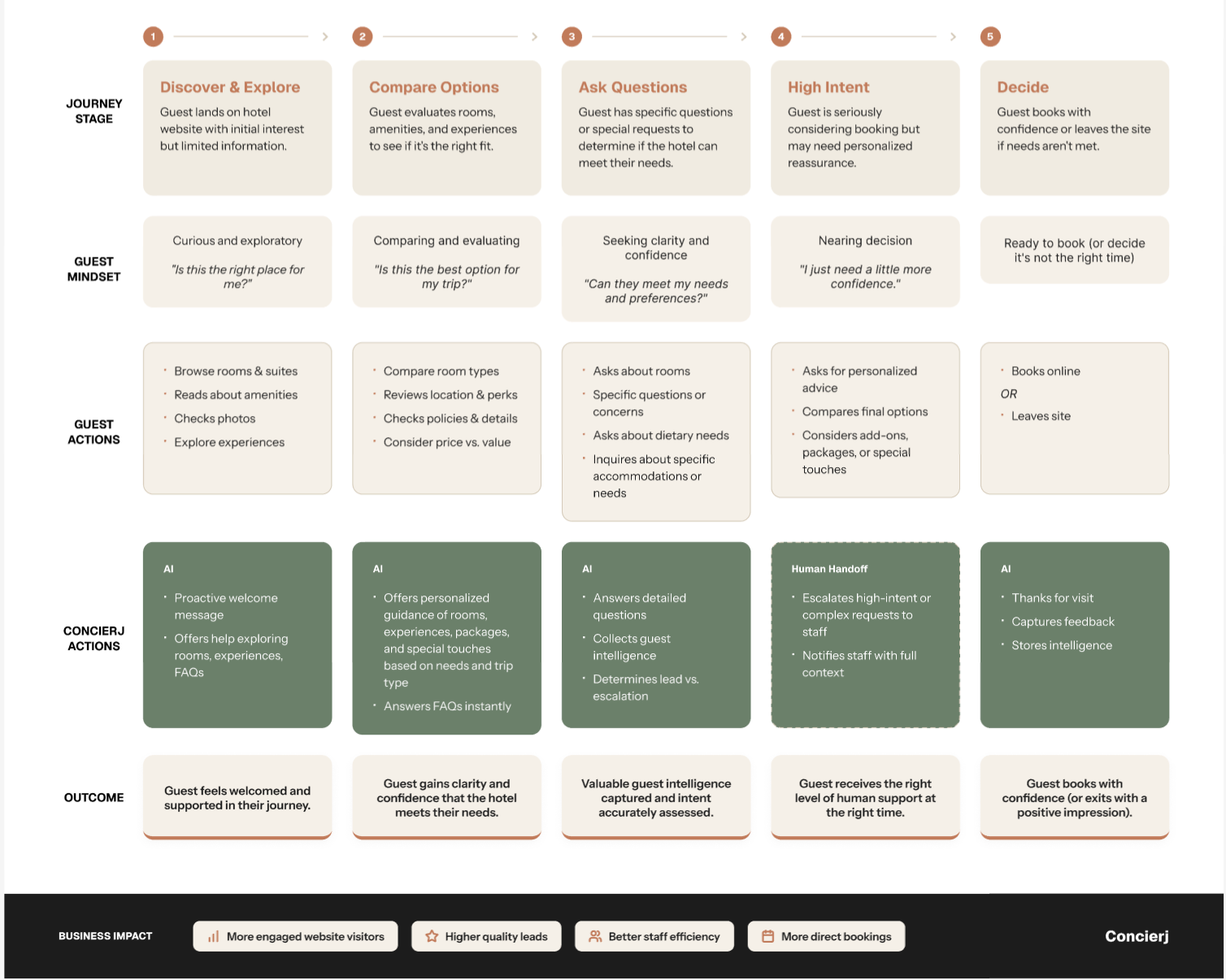
The guest journey map
After the interviews, I mapped the guest journey to see how prospective guests move through a hotel website during the decision stage. The map located the friction points, information gaps, and drop-off moments in the booking funnel, and where Concierj could intervene.
One insight stood out immediately: purchase intent is already high before booking, but guests get no guidance during consideration. Comparing rooms and experiences while hunting for specific information causes decision fatigue, and decision fatigue causes abandonment.
Key design decision: guided prompt bubbles that surface common guest questions and next steps. They cut cognitive load, speed up information discovery, and point guests toward what they're most likely looking for.
Feature map
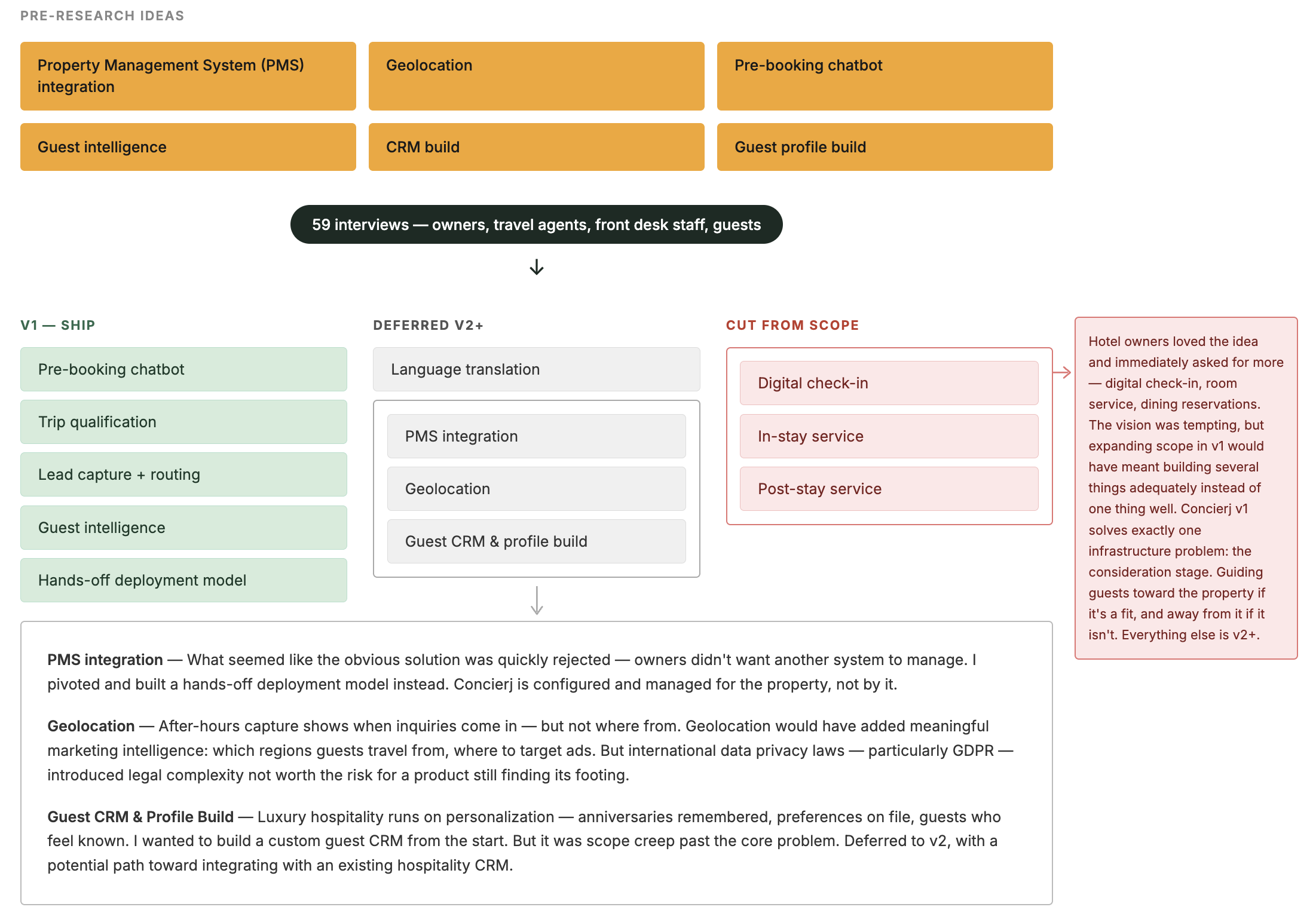
I turned the findings into a feature map to prioritize and scope the MVP: the core capabilities needed to support guests through the consideration stage without adding to staff workload.
Research reshaped the product four times over the course of the build.
Low-fidelity systems design
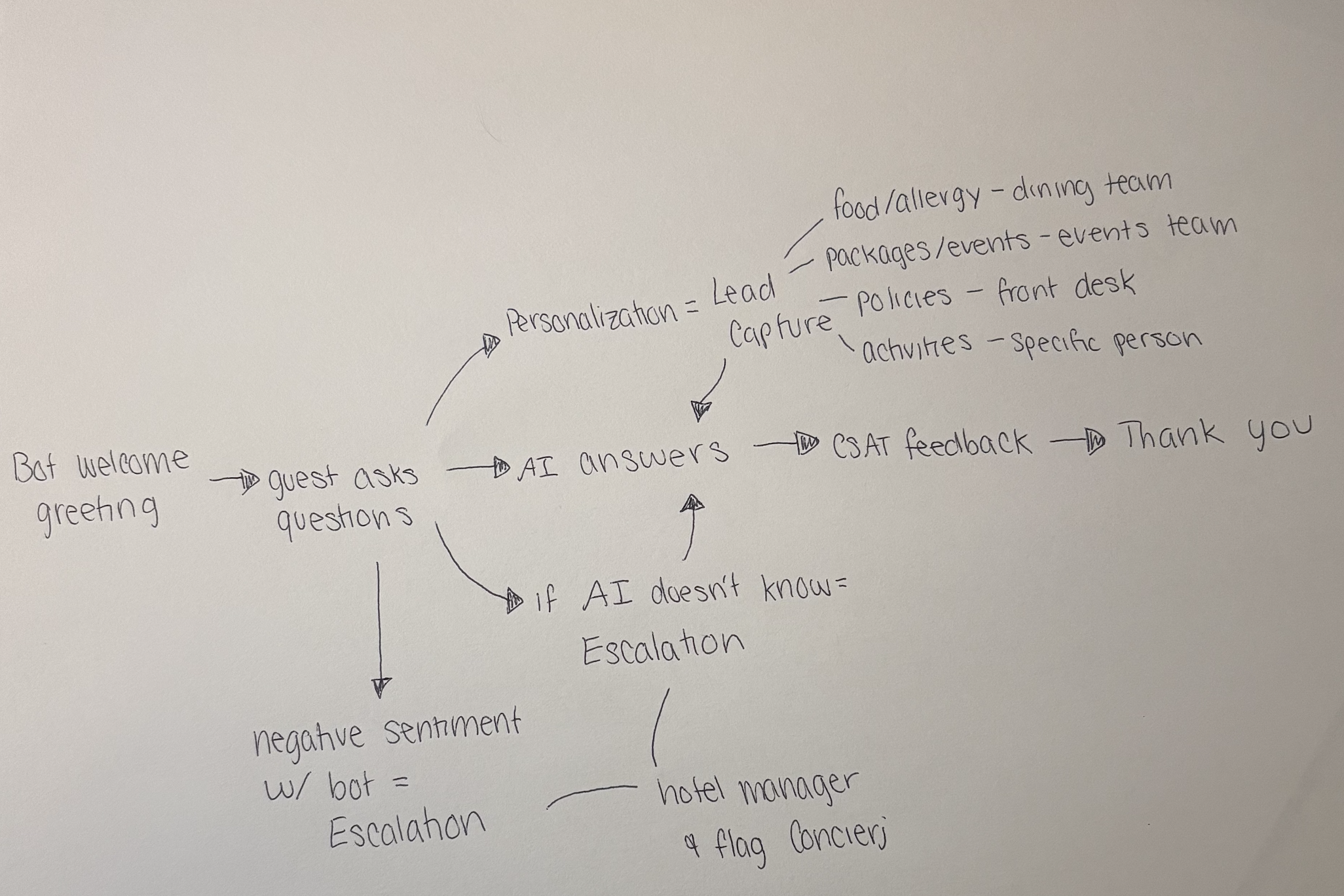
I started with low-fidelity sketches to work out how to identify and route different guest segments through the experience: lead qualification, escalation pathways, and human handoff triggers.
From there I mapped end-to-end conversation flows, tracing how a guest moves from an initial question to a booking decision, or to a human handoff through lead capture or escalation.
03 — Building the system
The goal wasn't a FAQ chatbot. It was a system that actively guides guests through the pre-booking journey while giving hotel staff something useful behind the scenes. Every component maps to one of Concierj's three core pillars:
Guests
Confident booking decisions:
- Personalized recommendations
- Reduced decision fatigue
- Guided trip planning
Staff
Human attention where it matters:
- Lead capture
- Smart escalations
- Conversation summaries
Hotel Leadership
Actionable guest intelligence:
- Inquiry trends
- Guest preferences
- Operational insights
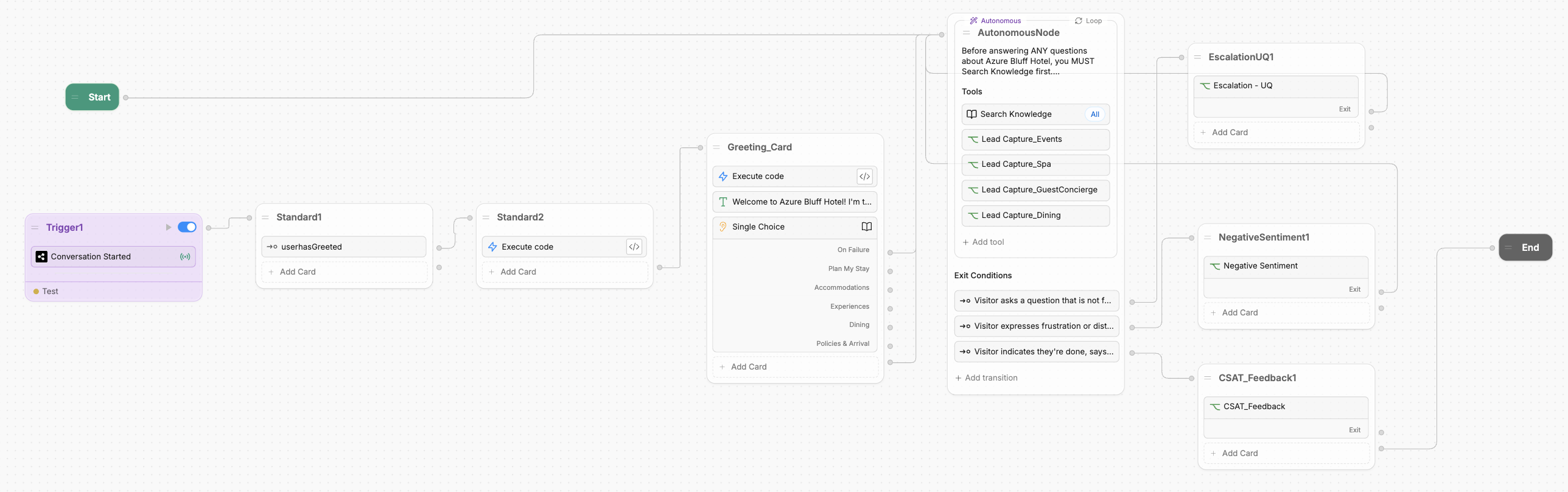
Conversational workflow architecture
What I built: standard nodes (after hours, guest feedback, new vs. returning guests) and an autonomous node (decision tree for room and experience recommendations, lead capture, escalation paths).
Why: interviews showed guests wanted guidance, not FAQ answers. The system needed to handle common questions, escalate high-intent guests, and build on the conversation as it went.
Key design decision: the autonomous node handles 98% of the service, proactively guiding guests through trip planning using personalized recommendations and suggested conversation paths, while capturing guest intelligence at the same time.
Knowledge base design
What I built: structured hotel information repository including room data, amenities, dining, policies, and local experiences.
Why: AI output is only as good as the information behind it and the guardrails against hallucination. Early testing showed generic responses cost guest trust.
Key design decision: organize content around guest decision-making rather than internal hotel departments, to speed up AI response time and cut token usage.
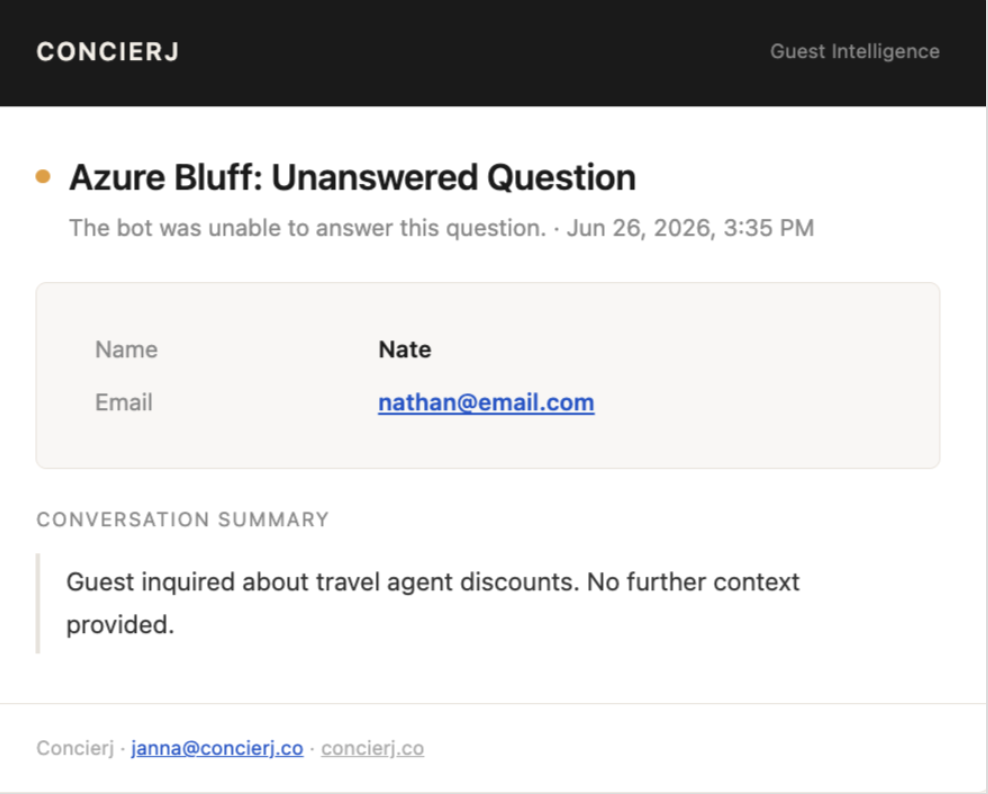
Human handoff and notifications
What I built: automated staff alerts, conversation summaries, and guest contact information.
Why: hotels don't need more conversations. They need visibility into the ones that matter.
Key design decision: deliver actionable context rather than raw chat transcripts.
Guest intelligence report
What I built: inquiry trend reporting, guest behavior insights, common questions, conversion indicators, and recommendations.
Why: every guest conversation is funnel data. Boutique hotels rarely capture or analyze it.
Key design decision: turn individual conversations into cohort-level insight on where guests convert and where they don't.
04 — Testing what breaks
I built a fully functional, high-fidelity prototype of Concierj in Botpress and tested it across 200+ real and simulated conversations with family, friends, advisors, and prospective guests. Testing ranged from structured booking scenarios to open-ended sessions built to surface edge cases and failure points.
Finding #1: guests weren't booking a room. They were planning a trip.
During testing I tried several approaches to starting that journey. Each improved information discovery, but testing surfaced something the prompts weren't addressing: guests needed confidence in the booking decision, not just an answer to a question. The final solution balanced information retrieval with personalized guidance.
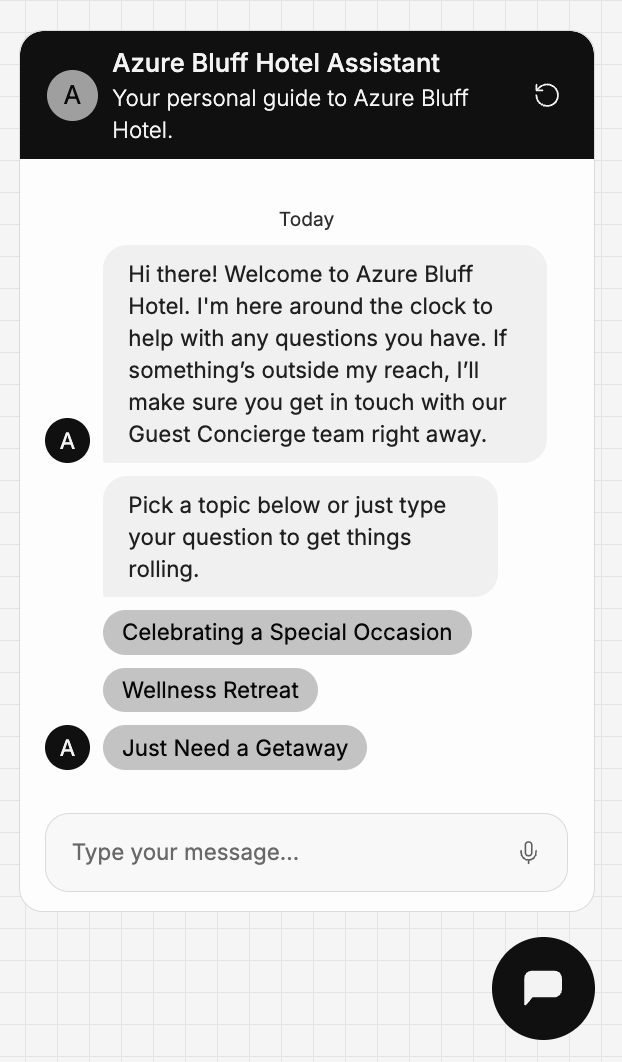
Iteration 1: lead with intent
The first version asked guests to self-identify their trip type, mirroring how an in-person concierge would qualify a guest. Testing surfaced a gap: travelers with family trips, group travel, or simple logistics questions didn't see themselves in any option, and even guests with a clear trip type felt boxed into one narrative before they'd asked their actual question.
Iteration 2: lead with information
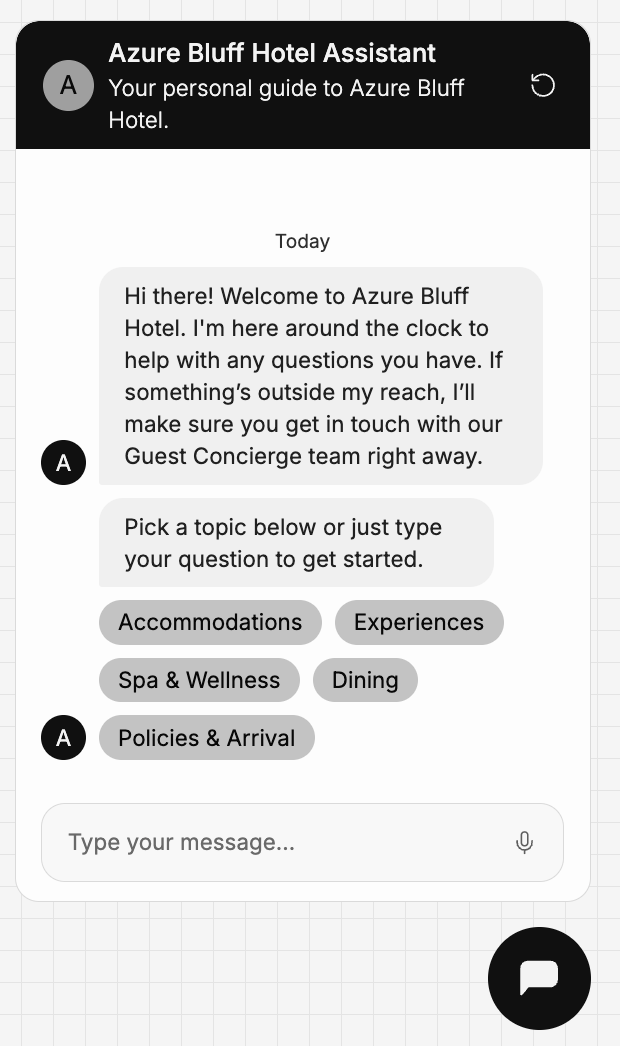
Next I replaced the qualifying prompts with broad category bubbles, closer to a standard FAQ menu. Guests responded to the directness: questions got answered fast, with no guesswork about where to click. But the format created its own friction. With no framing around intent, guests comparing rooms or experiences across categories hit decision fatigue.
Solution: lead with guidance
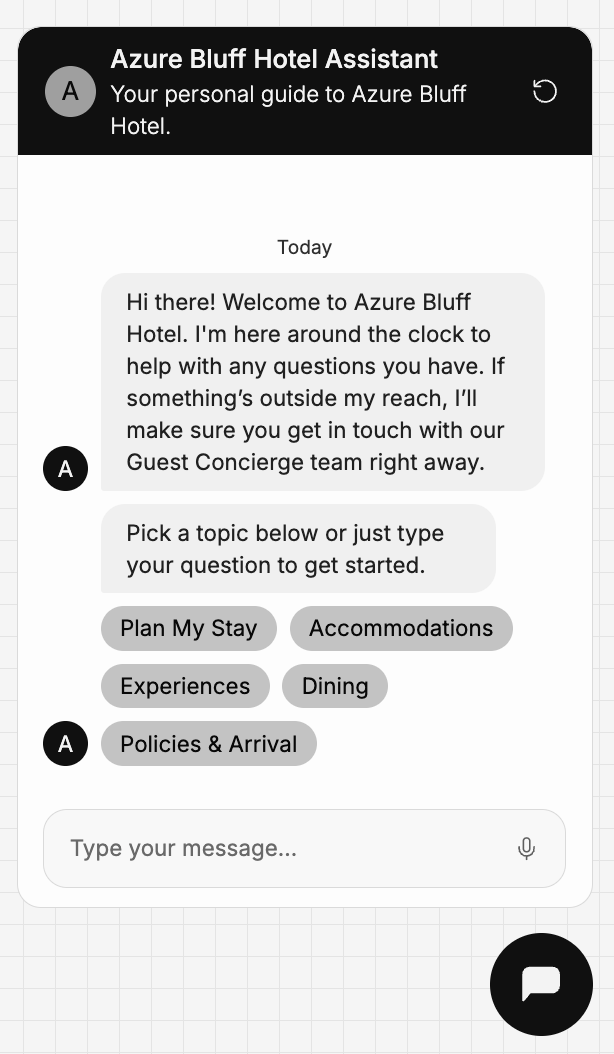
The winning version combined both: low-friction categories for guests who just needed information, plus a new "Plan My Stay" option for guests who wanted guidance. Plan My Stay opens with one prompt, tell me about your trip, and returns a personalized recommendation: specific rooms, activities, and touches tailored to what the guest shared, so they can picture themselves at the property before any logistics enter the conversation. From there, guests move into practical questions already sold on the stay. Engagement rose noticeably after the change, and Plan My Stay is now a core, defining feature of Concierj.
Finding #2: different situations need different summaries
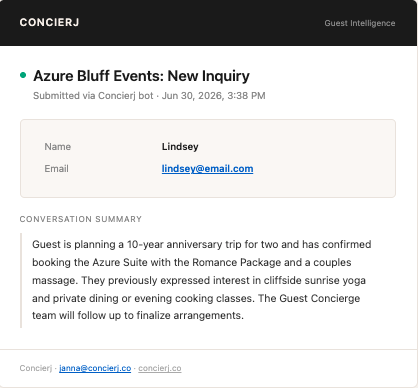
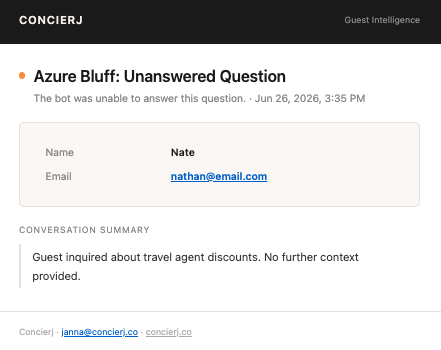
Early summaries were accurate but inconsistent. Some buried the signal in detail, others left out context staff needed for follow-up. Through testing and refinement, I built specialized summary frameworks for each conversation outcome, so staff get concise, actionable information tailored to the next step.
Key insight: the most useful summary depends on what action the hotel needs to take.
Finding #3: real guests don't follow happy paths
While the chatbot performed well during expected booking scenarios, testing revealed that users rarely follow ideal conversation paths. Participants frequently asked unexpected questions, changed topics mid-conversation, or interacted with the assistant in ways that differed from the designed workflow.
One of the most significant issues emerged when users opened the chatbot and immediately asked a question that was out of the assistant's scope. Rather than gracefully recovering, the assistant became trapped in an error state, failed to continue the conversation, and failed to trigger the escalation workflow.
To improve resilience, I redesigned the conversation routing logic and introduced fallback handling throughout the workflow. When a question cannot be answered through predefined paths, the assistant now routes to an autonomous AI node capable of determining the best next action.
Additional refinements included:
- Expanding fallback handling
- Improved autonomous node instructions
- Enhanced escalation logic
- Dedicated "on failure" routing paths
The assistant became significantly more resilient: fewer dead ends, and guests kept getting support even when conversations moved outside the predefined workflow. The fallback and escalation pathways let the system recover from uncertainty while cutting the odds of an inaccurate or hallucinated response.
Additional iterations:
- Increased chatbot visibility through proactive welcome messages, notification indicators, and sound cues.
- Refined widget sizing and placement to improve discoverability across user groups.
- Adjusted onboarding copy based on user feedback.
05 — Results & what's next
The workflows and user journeys were first designed in Figma, then built as a fully functional prototype in Botpress. I used Claude to generate and refine the custom code throughout development, which let me iterate and test quickly. The prototype went through 200+ conversational interactions and usability sessions, letting me continuously refine the guest experience, staff workflows, AI instructions, and routing logic.
The result is a fully functional conversational AI system that reads guest intent, guides different types of travelers toward a decision, escalates high-value moments to staff, and turns every conversation into guest intelligence.
Learnings
- The stated problem is rarely the real one: research showed a mismatch between what hotels were providing and what guests actually needed. Stay flexible on the solution and include real users from day one.
- Speed is a growth tool: building with Claude cut the time between idea and prototype dramatically. The faster a working experience got in front of users, the faster I could catch flawed assumptions, uncover edge cases, and iterate. Less time speculating, more time learning from real interactions.
- AI products are human-workflow products: the staff receiving the AI's output need as much design attention as the guest interacting with it. Handoffs and decision points are part of the product, not an afterthought.
- Shipping a product takes more than design: what started as a side project became a real venture. Beyond the product itself, I had to learn market positioning, technical constraints, and business viability. Growth work is equal parts strategy, adaptability, and persistence.